
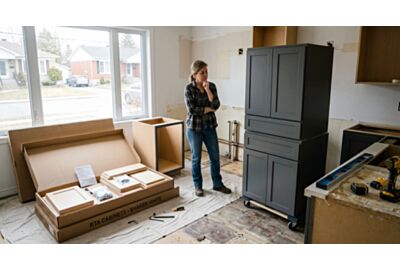
DIY vs. Pre-Assembled Kitchen Cabinets
The Cabinet Decision That Can Make or Break Your Kitchen Budget
You've got a number in your head — the absolute maximum you want to spend on this kitchen renovation. And then you start getting quotes. The cabinets alone are eating half the budget. Suddenly, you're online at midnight, deep in a rabbit hole of RTA cabinets versus pre-assembled kitchen cabinets, wondering if "ready-to-assemble" is a smart move or just a headache waiting to happen. Here's the truth: both options can deliver a beautiful, functional kitchen — but only one of them is right for your situation. And that depends on a handful of factors most comparison guides gloss right over.
The kitchen cabinet market has shifted dramatically over the last decade. What used to be a straightforward choice — call a cabinet company, pick a style, pay for installation — has evolved into something far more nuanced. DIY kitchen cabinets have gone from a budget compromise to a legitimate renovation strategy embraced by experienced homeowners and first-timers alike. At the same time, pre-assembled kitchen cabinets have gotten more competitive on price, more varied in style, and faster to deliver. So the old narrative that "RTA means cheap and pre-assembled means quality" simply doesn't hold up anymore.
What does that mean for you? It means the decision isn't about prestige or status — it's about fit. Your timeline. Your skill level. Your kitchen's layout complexity. And yes, your budget.
Speaking of budget: the cost gap between these two paths is real and worth taking seriously. Ready-to-assemble cabinets typically run 20–30% less than their pre-assembled counterparts. On a mid-size kitchen remodel, that can translate to thousands of dollars — money that could go toward better countertops, a smarter backsplash, or simply staying out of debt. The savings come from a straightforward logistical reality: flat-pack shipping is dramatically cheaper than moving fully built cabinet boxes across the country. Less shipping volume, less freight cost, and no labor baked into the price for assembly work you're doing yourself.
But cost isn't the whole story. Never is.
Pre-assembled cabinets have a genuine edge when it comes to installation speed and consistency. They arrive built, squared, and ready to hang. For homeowners who'd rather not spend a weekend with an Allen wrench and a YouTube tutorial, or for those working with contractors who charge by the hour, that factory-built convenience carries real value. A skilled contractor can hang pre-assembled cabinets in a matter of hours. RTA cabinets? You're looking at anywhere from a solid afternoon to a couple of full days, depending on the size of your kitchen and how handy you are.
There's also the quality question — and this is where the conversation gets more interesting than most people expect. The assumption that pre-assembled automatically means better-built is outdated. Premium RTA cabinet brands have closed the gap considerably. With the right materials, proper joinery, and careful assembly, an RTA cabinet from a reputable supplier can perform just as well as anything that arrived pre-built. The variable isn't the product — it's the assembly. Which is exactly why choosing a supplier that offers real support, clear instructions, and high-quality components matters so much.
That's the kind of experience 10 Percent Cabinetry is built around. Rather than leaving homeowners to figure it out alone, they pair premium budget kitchen cabinets with free design consultations and expert guidance — because a great cabinet at a great price still needs to end up in the right place, in the right configuration, installed correctly. The product and the support together are what make a kitchen remodel actually work.
So whether you're leaning toward the hands-on satisfaction of assembling your own cabinetry or you want the speed and certainty of pre-assembled units, the sections ahead will walk you through what actually separates these two paths — not in vague generalities, but in the specific, practical details that matter when you're standing in a half-demolished kitchen trying to make the right call.
Understanding the Real Difference Between RTA and Pre-Assembled Cabinets
The names say a lot, but they don't say everything. Ready-to-assemble cabinets ship flat-packed — panels, hardware, and components bundled together, designed to be put together on-site by the homeowner or installer. Pre-Assembled Kitchen Cabinets, on the other hand, arrive as fully constructed boxes, built in a factory and ready to mount the moment you unpack them. That fundamental difference — assembled versus unassembled — creates a ripple effect across cost, shipping, timeline, and installation experience.
Let's get into the specifics, because this is where most comparisons fall short.
How Shipping and Logistics Shape the Price
One of the most underappreciated reasons RTA cabinets cost less has nothing to do with material quality. It's physics and freight. A flat-packed cabinet takes up a fraction of the shipping space that a fully assembled box requires. You can stack panels efficiently, consolidate hardware, and ship far more product per truckload. That efficiency gets passed back to the consumer.
Pre-assembled cabinets are bulky by definition. They have to be crated carefully to prevent damage during transit, which adds both material and labor costs to every shipment. Larger trucks, more protective packaging, longer delivery windows — it all adds up before the cabinet ever touches your kitchen floor. This isn't a flaw in pre-assembled cabinets; it's just the cost of shipping a three-dimensional structure instead of a flat kit. But understanding this helps you see why the price difference between the two isn't a reflection of quality so much as it is a reflection of logistics.
Construction Methods and What They Mean for Durability
Here's the thing most guides skip over: the way a cabinet is put together has a significant impact on how long it lasts — and both RTA and pre-assembled cabinets can be built well or built poorly.
Factory-assembled cabinets are built using industrial equipment and consistent techniques. Dowels, staples, dado joints, and glue are applied under controlled conditions. The quality control at a reputable factory is real, and the results are consistent. You know what you're getting from box to box.
RTA cabinets introduce a variable: the assembler. When assembled correctly — following instructions carefully, ensuring panels are square, driving hardware to proper depth — the finished product can match factory quality without compromise. Premium RTA lines, like the ones available through 10 Percent Cabinetry, use the same core materials and joinery methods as their pre-assembled counterparts. Plywood boxes, soft-close hardware, dovetail drawer construction — these aren't features reserved for pre-assembled lines anymore.
The risk with RTA assembly is human error. A panel forced into the wrong orientation, a cam lock that's slightly misaligned, a box that's just barely out of square — these small mistakes compound. They can cause drawer misalignment, door gaps, and in worse cases, structural instability over time. The fix isn't to avoid RTA cabinets. It's to take assembly seriously, use proper tools, and work with a supplier who provides detailed instructions and support when you hit a snag.
Style, Finish, and Customization Options
Both cabinet types come in a wide range of door styles, finishes, and configurations — shaker, flat-panel, raised panel, painted, stained, thermofoil. The idea that RTA means limited options is a myth. Modern DIY kitchen cabinet lines offer just as much visual variety as pre-assembled collections.
Where pre-assembled cabinets sometimes pull ahead is in built-in complexity. Specialty storage features — pull-out trays, integrated drawer dividers, lazy Susans with specific mounting requirements — are sometimes easier to implement in pre-assembled form because the factory handles the tricky integration work. That said, many RTA lines now offer these same accessories as modular add-ons, so the gap has narrowed.
RTA cabinets do offer a flexibility advantage in one specific scenario: when you need to customize individual components before everything is locked together. Want to adjust the interior layout of a base cabinet before the box is fully assembled? With an RTA cabinet, you can. With a pre-assembled unit, you're working with what arrived.
The Role of the Supplier
Whether you go RTA or pre-assembled, the supplier relationship matters more than most homeowners account for when they're comparing price tags. Cabinet quality varies enormously within both categories. A cheap pre-assembled cabinet made from particleboard with stapled joints isn't better than a premium RTA cabinet just because it arrived built. And a poorly designed RTA kit with confusing instructions and substandard hardware can turn a manageable DIY project into a genuine ordeal.
Choosing a supplier like 10 Percent Cabinetry — one that combines quality materials with free design support and genuine expertise — changes the calculus entirely. The product is only part of the equation. Knowing what to order, how to configure the layout, and having someone to call when something doesn't make sense? That's the difference between a renovation that goes smoothly and one that stalls out halfway through.
What You Actually Gain — and Give Up — With Each Option
Comparisons are easy to make on paper. Real renovations are messier. So let's talk about what each path actually looks like when it's your kitchen, your weekend, and your money on the line.
The Real Cost Advantage of RTA Cabinets
That 20–30% savings figure isn't theoretical. On a kitchen with $10,000 worth of pre-assembled cabinetry, choosing quality RTA cabinets instead could realistically save $2,000 to $3,000. That's not a rounding error — that's a new appliance, a tile upgrade, or a significant dent in your overall renovation budget.
For budget-conscious homeowners, this is the most compelling argument for going the DIY kitchen cabinet route. And it doesn't require sacrificing quality. Premium affordable kitchen cabinets in RTA format — the kind built from solid plywood boxes with soft-close hinges and dovetail drawer joints — will perform just as well over the long term as comparably priced pre-assembled options, assuming proper assembly.
The savings also compound. If you're managing a full kitchen remodel, every category has a budget: appliances, countertops, flooring, lighting, labor. Cutting cabinet costs meaningfully gives you breathing room everywhere else. Homeowners who start with a realistic cabinet budget and choose RTA often end up with a better overall kitchen than those who blew most of their budget on pre-assembled cabinets and had to cut corners on finishes.
Installation Time — Honest Numbers
Let's be real about the time commitment here, because this is where a lot of first-time RTA buyers get surprised.
Pre-assembled cabinets, installed by a competent contractor or a confident DIYer, can go up in a single day for a standard-sized kitchen. The boxes are ready. You level, mount, and secure. There's no assembly phase — just installation. That speed has genuine value, especially if you're working around a contractor's schedule or living without a functional kitchen for as short a time as possible.
RTA cabinets add a phase. Before installation comes assembly — and that's where the time adds up. A well-organized, experienced assembler might knock out a kitchen's worth of RTA cabinets in a day. Someone doing it for the first time, in a garage, with the instructions spread out on the floor? Plan for two to three days, minimum. That's not a knock on the process. It's just honest.
The key variables are kitchen size and personal skill level. A galley kitchen with 15 cabinets is a very different project than an L-shaped kitchen with 30-plus boxes. And someone who's comfortable with tools, precise with measuring, and patient with instructions will finish faster and with better results than someone who's rushing or unfamiliar with the hardware.
Consistency and Peace of Mind
One of the underrated benefits of pre-assembled kitchen cabinets is consistency. Every box comes out of the factory built to the same standard. There's no assembly variation, no user error, no "did I tighten that cam lock properly?" moment. For homeowners who want certainty — especially those hiring a contractor who's charging by the hour — that consistency translates to a more predictable installation and a more predictable bill.
Pre-assembled also tends to be more forgiving when you're not deeply involved in the project. If you're managing a full renovation from a distance, or if you're relying on a contractor to handle everything while you're at work, pre-assembled cabinets require less coordination and less oversight. They arrive ready. The contractor hangs them. Done.
Flexibility and the DIY Mindset
RTA cabinets reward a certain kind of homeowner — one who's engaged, hands-on, and comfortable with a project that takes effort before it delivers results. That's not a criticism of the approach; it's just an honest description of who tends to get the most out of it.
And honestly? There's something genuinely satisfying about assembling your own cabinetry. You know every component. You understand how it's built. If something needs adjustment down the road, you're not guessing at the construction — you were there. That familiarity has practical value over the life of a kitchen.
The flexibility angle is real too. With RTA cabinets, you can mix and match components from the same line to create custom configurations that work for your specific layout. You're not locked into box sizes that don't quite fit your space. Pre-assembled lines offer flexibility too, but you're choosing from finished products rather than building from components — which limits some of the fine-tuning that hands-on assembly allows.
For homeowners who fall into this hands-on category and want to stretch their kitchen remodel budget as far as possible, working with a supplier like 10 Percent Cabinetry gives them the best of both worlds: quality RTA cabinetry that performs at a premium level, backed by free design consultations that help ensure the layout is right before a single panel gets assembled. That kind of support eliminates a lot of the risk that makes people hesitant about the DIY path in the first place.
```How to Choose and Install the Right Cabinets for Your Kitchen
Let's get practical. Whether you're leaning toward RTA cabinets or pre-assembled kitchen cabinets, the decision only pays off if you go in with a real plan. Here's what actually matters when you move from research to renovation.
Measure Twice — Then Measure Again
Before you order a single cabinet, you need accurate kitchen measurements. This sounds obvious, but it's where a surprising number of homeowners stumble. Get the overall width, height, and depth of every wall section. Note where windows, doorways, and appliances sit. Account for plumbing under the sink and gas lines if you're working near a range.
A quarter-inch error in a single wall measurement can cascade into a layout problem that costs you hundreds to fix. If you're not confident doing this yourself, most kitchen design software — including the free consultation service offered by 10 Percent Cabinetry — will walk you through it. That free design session exists precisely for situations like this.
Plan Your Layout Before You Order
Once measurements are locked in, sketch out your layout. Think about the work triangle — that classic relationship between your sink, stove, and refrigerator. Cabinets that look great on paper can turn into workflow nightmares if they interrupt that triangle or crowd a heavily-used corner.
Decide upfront where you want deep base cabinets versus standard ones, which spots call for drawers versus doors, and whether you need any specialty units like a lazy Susan corner cabinet or pull-out trash organizer. With RTA cabinets, this is actually an advantage — you select each component individually, so you can mix and match configurations to suit your specific kitchen rather than working around a preset package.
Setting Up Your Assembly Space
If you're going the DIY kitchen cabinet route, workspace matters more than most guides acknowledge. You'll want a large, flat surface — a garage floor with a drop cloth works well — where you can lay out pieces without crowding. Keep hardware organized in labeled bags or a muffin tin so you're not hunting for cam locks mid-assembly. A cordless drill, a rubber mallet, and a good square are the three tools you'll reach for constantly.
Build all your cabinet boxes before you start mounting anything. It's faster to get into a rhythm assembling one after another than to build, mount, build, mount. Once every box is assembled and you've confirmed the doors hang correctly, you're ready to move to installation.
The Installation Sequence That Saves Headaches
Start with your upper cabinets. Always. If you mount the lowers first, you're working around them with heavy upper units, which is awkward and risky. Find your highest point along the floor — floors are almost never perfectly level — and use that as your reference line. Snap a chalk line for your upper cabinet base height, then snap a second line for your lower cabinet tops.
Locate and mark every wall stud. Cabinets need to be anchored into studs, not just drywall. Use a ledger board — a temporary horizontal board screwed into the studs — to support your upper cabinets while you fasten them. Once they're secured, remove the ledger and move to your base cabinets.
Shim as needed. Shims are your best friend when you're dealing with out-of-level floors or slightly wavy walls. Take your time getting each cabinet plumb and level before you fasten the adjacent one. Once you screw cabinets together face-to-face with the provided hardware, any alignment errors become permanent. This is the one part of the job where patience genuinely pays off.
Finishing Details That Make or Break the Look
Doors and drawer fronts are the face of your kitchen. Adjust hinges until every door is perfectly aligned — most concealed hinges have three-axis adjustability, so use it. Even a two-millimeter gap difference between doors is noticeable once everything is installed. Take the extra twenty minutes to get it right.
Fill any gaps between cabinets and walls with scribe molding. Add crown molding at the top if you want that built-in, finished look. These details cost relatively little and dramatically elevate the final result. With premium ready-to-assemble cabinets from 10 Percent Cabinetry, matching trim and molding pieces are typically available as part of the same line, so you're not trying to hunt down something that looks close enough.
One last thing: don't install your countertops until every cabinet is fully mounted, leveled, and all doors and drawers are adjusted. Countertop templating off incorrectly positioned cabinets is an expensive mistake that's entirely avoidable.
What Most People Get Wrong About the RTA vs. Pre-Assembled Debate
Zoom out from the individual product specs and cost comparisons, and a more interesting picture emerges. The kitchen cabinet comparison that most homeowners fixate on — RTA versus pre-assembled — often isn't really about cabinets at all. It's about assumptions. About what "quality" looks like, what "affordable" actually means over time, and whether saving money upfront translates into a better or worse kitchen down the road.
Here's the perspective that tends to get lost in the noise.
The Quality Myth That Keeps Circulating
There's a persistent belief that pre-assembled automatically means better. The logic seems reasonable: factory-built with professional equipment equals more consistent construction. And there's truth to that — but it's not the full story.
Cabinet quality isn't determined by whether it arrived assembled. It's determined by the materials used, the joinery method, the finish quality, and the hardware spec. A pre-assembled cabinet built with particleboard carcasses and stapled joints is a worse product than a premium RTA cabinet built with solid plywood boxes, dovetail drawer joints, and soft-close hardware — even if the RTA unit required you to spend a Saturday afternoon assembling it.
The cabinet industry has quietly shifted in the last decade. What was once a significant quality gap between flat-pack and pre-assembled has largely closed at the mid-to-premium tier. Brands like 10 Percent Cabinetry have leaned into this reality, offering ready-to-assemble cabinets built to the same structural standards you'd expect from pre-assembled lines — the main difference being how they arrive at your door.
The Hidden Cost Nobody Talks About
Pre-assembled cabinets carry a premium that's only partly about the product itself. You're also paying for the cubic footage of shipping space those fully-built boxes occupy. A set of pre-assembled cabinets for a mid-sized kitchen can require multiple large freight deliveries. That's reflected in the price, whether it's itemized or not.
Budget kitchen cabinets in RTA format ship flat — stacked efficiently, with far lower freight costs — and those savings get passed to you. It's not a trick or a trade-off. It's just logistics. The 20 to 30 percent cost difference between comparable RTA and pre-assembled lines often comes down to this factor as much as anything else.
And yet most people looking at a side-by-side price comparison assume the RTA version must be lower quality to justify the lower price. That assumption is costing some homeowners real money — either by pushing them toward pre-assembled products they didn't need, or by steering them away from affordable kitchen cabinets that would have served them just as well.
What Renovation Professionals Actually Think
Kitchen installers and remodeling contractors have a complicated relationship with RTA cabinets. Some prefer pre-assembled because the installation is faster, which means they can quote you less labor. Others — particularly those working on tighter renovation budgets — actively recommend quality RTA lines because the product cost savings leave more room in the budget for countertops, backsplash, or appliances that the client actually cares about.
The honest industry take? The best cabinet is the one that fits your budget, your timeline, and your kitchen's specific requirements. Professionals who tell you otherwise are usually selling something.
The DIY Confidence Variable
One factor the industry rarely addresses directly: not everyone is equally suited to a DIY kitchen cabinet installation, and that's completely fine. Assembly skill, available time, tolerance for problem-solving mid-project — these vary widely. Someone who's never held a power drill shouldn't be persuaded into a full RTA install just because the savings look attractive on paper.
But here's what's changed: the support infrastructure around RTA cabinets has grown significantly. Free design consultations, detailed installation guides, video walkthroughs, and direct customer support from companies like 10 Percent Cabinetry mean the knowledge gap between a DIYer and a seasoned installer has genuinely narrowed. The learning curve is real, but it's not as steep as it was ten years ago.
The Bigger Picture for Your Kitchen Remodel
A kitchen remodel is one of the most significant investments a homeowner makes — both financially and in terms of daily quality of life. Cabinets represent roughly 30 to 40 percent of a typical kitchen renovation budget. Getting that decision right ripples outward. It affects how much you have left for everything else. It affects how long the project takes. It affects whether you're proud of the finished result or quietly wishing you'd made a different call.
The RTA vs pre-assembled debate, at its core, is a question of where you want to invest your time versus your money. Neither answer is wrong. But going in with accurate information — rather than inherited assumptions about what "DIY" means or what "assembled" guarantees — is what separates a renovation you're happy with from one you're still thinking about years later.
Making the Call: Which Cabinet Choice Actually Wins?
After everything — the cost breakdowns, the installation logistics, the quality comparisons, the expert context — it comes down to something simpler than most people expect. The right cabinet choice is the one that fits your actual life, not an idealized version of your renovation.
And honestly? That clarity is worth more than any single piece of product advice.
If you've been doing the mental math throughout this article, you probably already have a sense of which direction makes sense. But let's make it concrete.
When RTA Cabinets Are the Right Move
RTA cabinets — and DIY kitchen cabinets more broadly — reward a specific kind of homeowner. You're comfortable with tools, or at least willing to learn. You have a weekend or two available to dedicate to assembly and installation. Your renovation budget is a real constraint, not just a preference. You want control over the process and the flexibility to customize individual cabinet components before anything gets assembled.
If that sounds like you, the savings are real and the results can be exceptional. The 20 to 30 percent cost difference between comparable ready-to-assemble cabinets and pre-assembled lines isn't marginal — on a full kitchen, that's often several thousand dollars. That money can go toward better countertops, higher-end appliances, or simply staying under budget in a project that almost always finds ways to expand.
10 Percent Cabinetry was built around this kind of homeowner. Their affordable kitchen cabinets are designed to deliver premium quality without the premium price tag, backed by free design consultations and the kind of support that makes a DIY installation actually feel manageable. You're not just buying flat-packed boxes — you're getting a team that wants your kitchen to turn out right.
When Pre-Assembled Cabinets Make More Sense
Pre-assembled kitchen cabinets are the better fit when time is the binding constraint. If you're on a hard deadline — a renovation that needs to wrap before a move, a kitchen that can't be out of commission for more than a few days — the ability to unbox, mount, and be done is genuinely valuable. Same goes if you're hiring installation labor and your contractor's hourly rate makes a longer assembly process a net negative.
There's no shame in choosing convenience. A kitchen remodel is stressful under the best circumstances. If removing the assembly step preserves your sanity and still delivers a kitchen you love, that's a legitimate win. Just go in with clear eyes about what you're paying for — a faster path to the same destination, not necessarily a better product.
The Question Worth Asking Before You Decide
Here's the one question that cuts through all the noise in any kitchen cabinet comparison: What would you do with the money you save?
If the answer is "put it toward something else I care about in this kitchen" — better hardware, upgraded lighting, a tile backsplash you've been eyeing — then budget kitchen cabinets in RTA format are probably your move. The savings are real, the quality ceiling is high, and the process is more manageable than it looks from the outside.
If the answer is "I'd rather just not think about it" — that's useful information too. Value isn't only measured in dollars. Time and peace of mind are real currencies in a renovation.
A Final Thought on the Bigger Decision
The RTA vs pre-assembled debate has been framed for years as a trade-off between savings and quality. That framing is outdated. Premium ready-to-assemble cabinets have closed the quality gap significantly. What remains is a genuine choice between different ways of getting to the same place — a functional, beautiful kitchen that reflects how you actually live.
Most homeowners who go the DIY kitchen cabinet route with a quality supplier don't look back. They're proud of the work, and the savings give them breathing room in a project full of unexpected costs. Most homeowners who choose pre-assembled kitchen cabinets for the right reasons — speed, simplicity, specific timeline pressures — are equally satisfied.
What separates a successful kitchen remodel from a frustrating one isn't usually the cabinet type. It's preparation, realistic expectations, and working with people who actually know what they're doing.
10 Percent Cabinetry offers both RTA cabinets and a team of design consultants who can help you figure out which direction serves your kitchen and your budget best — without pushing you toward any particular answer. If you're in the middle of this decision, their free design consultation is one of the more useful places to start. Bring your measurements, your layout sketch, and your questions. You'll leave with more clarity than you came in with.
Your kitchen deserves a choice made with full information. Now you have it.