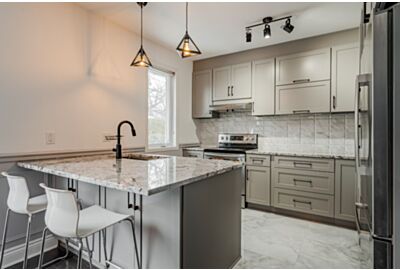
There is nothing worse in the world of home improvement than a stalled renovation. You have likely heard the horror stories: a homeowner tears out their old kitchen, the contractor is ready to go, the plumbing is roughed in, and then… silence. They end up living off paper plates and microwave meals for four months because the cabinets are stuck on a shipping container somewhere in the middle of the ocean.
At 10 Percent Cabinetry, we believe your kitchen should be built in your home, not waiting in a queue. Logistics isn't just about moving boxes; it is the backbone of a successful remodel. Whether you are a contractor in the suburbs of Cincinnati trying to keep a schedule or a DIY enthusiast in the wider USA, understanding how your cabinets get to you is as important as choosing the color.
This guide dives deep into the mechanisms of cabinet shipping, how we achieve industry-leading speeds, and the financial and practical implications of lead times on your project.
The Logistics of Speed: How We Achieve Quick Ship Outcomes
In the current construction climate, "speed" is often a marketing buzzword rather than a reality. However, true speed in cabinetry delivery is a result of calculated supply chain management and geographic strategy. For homeowners and contractors specifically looking for quick ship cabinets Ohio, the location of the distribution hub is everything.
The Midwest, specifically the Cincinnati region, serves as a massive logistical advantage. From a freight perspective, Cincinnati is within a one-day drive of nearly 60% of the United States population. This isn't just a fun fact; it is a mathematical advantage for shipping costs and speed. When we ship from a central hub, we avoid the coastal bottlenecks that plague companies relying solely on ports in Los Angeles or New Jersey.
The Inventory Strategy
Most cabinet retailers operate on a "Just-in-Time" (JIT) manufacturing model. This means they don't actually build or box your cabinet until you order it. While this saves them storage costs, it costs you time—usually 6 to 12 weeks. 10 Percent Cabinetry operates differently. We utilize a "stocking distributor" model. This means the inventory is physically sitting in the warehouse, boxed, strapped, and ready for a label before you even click "checkout."
The Warehouse Workflow
To understand why some cabinets ship in 3 days and others in 3 months, you have to look at the warehouse workflow. Here is the process that ensures speed:
Order Batching: Orders aren't pulled randomly. They are batched by shipping route to ensure carriers pick them up efficiently.
Palletization: Unlike small parcels (like an Amazon box), cabinets must be palletized. We build custom pallets to fit the specific footprint of your kitchen order, ensuring stability during transit.
Carrier Relationships: We don't just use one truck line. We bid out freight lanes to find the carrier that is currently moving fastest to your specific zip code.
By controlling the inventory and the geographic starting point, we remove the variables that cause delays. You aren't waiting for paint to dry; you are simply waiting for a truck to drive.
Managing the Gantt Chart: The Reality of Kitchen Remodel Lead Times
Time is money. In construction, this is literal. A delayed cabinet delivery doesn't just push back the installation; it creates a domino effect that ruins the schedules of the countertop fabricator, the plumber, the electrician, and the tile setter. Understanding kitchen remodel lead times is the only way to effectively manage a project.
The "Critical Path" in Construction
In project management, the "Critical Path" is the sequence of stages determining the minimum time needed for an operation. Cabinets are almost always on the critical path. You cannot template countertops until base cabinets are installed. You cannot install the sink until the countertops are in. You cannot finish the backsplash until the counters are set.
If you order custom cabinets with a 12-week lead time, your kitchen is a construction zone for at least 3 months. If you order stock cabinets with a 2-week lead time, you have shaved 10 weeks off your living inconvenience. Let’s look at the phases of a standard kitchen remodel and where shipping fits in:
Phase
Action
Cabinet Dependency
Phase 1: Demolition
Tearing out old fixtures and drywall.
Low. You can demo before ordering, but it's risky if shipping is delayed.
Phase 2: Rough-In
Plumbing, electrical, and HVAC work inside walls.
Medium. You need the cabinet specs (dimensions) to place pipes/outlets correctly.
Phase 3: Ordering
Purchasing the cabinetry.
CRITICAL. This is the bottleneck. High lead times here stop all future work.
Phase 4: Installation
Hanging boxes, leveling, securing.
High. Material must be on-site and inspected.
The "Buffer" Fallacy
Many homeowners try to build a "buffer" by ordering cabinets months in advance. While safe, this creates a storage problem. Do you have 400 square feet of climate-controlled garage space? If not, storing wood cabinets in a humid garage or a damp basement can warp the doors before they are even installed. The ideal scenario is a "Just-in-Time" delivery to your home, which requires a supplier with predictable, fast shipping.
Financial Analysis: Wholesale Economics vs. Retail Markups
When you walk into a big-box store, you are paying for the showroom lighting, the sales staff commissions, and the corporate branding. When you look for Wholesale Cabinets Cincinnati or similar direct-to-consumer options, you are stripping away the overhead that doesn't add value to the product itself.
The Cost of "Holding"
In the cabinet industry, space is expensive. Retailers who display fully assembled kitchens pay massive rent per square foot. They pass this cost to you. 10 Percent Cabinetry focuses on warehouse efficiency rather than showroom glamour. By keeping our stock in high-density racking systems rather than staged vignettes, we reduce the "cost per box."
Price vs. Quality: The Misconception
A common myth is that if it ships fast and is affordable, it must be "cheap" quality. This is a misunderstanding of manufacturing. High prices in custom cabinetry often come from inefficiency, not just better wood. Custom shops have high waste percentages and labor hours per cabinet.
Wholesale cabinets are mass-produced using automated machinery that ensures consistent cuts and finishes (often better than a local carpenter can achieve by hand) but at a fraction of the labor cost. We use solid plywood boxes and maple frames—premium materials—but because we buy them by the container load, our input costs are significantly lower than a local shop buying wood from a lumber yard.
Freight Cost Impact
Shipping isn't free, even when it says "Free Shipping." It is baked into the price. In the wholesale model, we are transparent about logistics. Because we ship high volumes, we negotiate aggressive rates with LTL (Less-Than-Truckload) carriers. A custom shop shipping one kitchen across the country pays premium "spot rates." We pay volume contract rates, and that savings is the difference that allows you to upgrade from particle board to plywood without breaking the budget.
The "Near Me" Factor: Why Digital Proximity Matters More
Ten years ago, searching for cabinet delivery near me meant looking for a shop within a 20-mile radius. Today, "near me" is defined by accessibility and speed of delivery, not physical distance. In the digital age, a warehouse in Ohio can be "closer" to a customer in Florida than a custom shop in the next town over, simply because of production capacity.
The Local Pickup vs. Last Mile Delivery Debate
For our Cincinnati locals, the ability to pick up directly from the warehouse is a massive perk. It eliminates freight damage risk entirely and cuts costs. However, for the rest of the country, the "Last Mile" experience is what defines "local."
The "Last Mile" is the final step of the delivery process—from the local distribution center to your driveway. We utilize carriers equipped with lift-gates (hydraulic platforms that lower the pallet to the ground). This means you don't need a forklift or a loading dock at your house. The truck pulls up, the driver unloads the pallet to the curb, and suddenly, the cabinets are "near you."
Communication is Proximity
What makes a supplier feel distant? Lack of communication. If you order cabinets and don't hear anything for six weeks, the supplier feels like they are on Mars. If you receive tracking updates, text notifications about delivery windows, and calls from the dispatch team, the supplier feels like a local partner. We invest heavily in the software side of shipping to ensure that you know exactly where your kitchen is at every moment.
RTA vs. Pre-Assembled: The Shipping Safety Analysis
One of the biggest decisions you will make is choosing between Pre-Assembled or RTA cabinets USA shipping. While pre-assembled sounds convenient, RTA (Ready-To-Assemble) offers superior advantages specifically regarding shipping safety and cost.
The Physics of Shipping Air
When you ship a pre-assembled cabinet, you are paying to ship a box full of air. A 30-inch cabinet takes up substantial cubic footage in a truck. Carriers charge based on density and volume. RTA cabinets are flat-packed. We can fit an entire kitchen on one or two pallets. This density reduces freight costs dramatically, allowing us to put that money back into the quality of the wood.
Damage Mitigation
This is the industry's dirty secret: Pre-assembled cabinets get damaged frequently during shipping. A fully built cabinet is rigid; if the truck hits a pothole or the pallet is dropped, the joints can crack, frames can rack (twist), and drawers can come off tracks.
RTA cabinets, by contrast, are packed flat in dense layers with foam protection. They are incredibly resilient to impact. Because the pieces are not under tension until you assemble them, they travel much safer. If a single door is scratched in an RTA pack, we can ship you a replacement door quickly. If a pre-assembled cabinet frame cracks, the whole unit must be scrapped and replaced.
Feature
RTA (Ready-To-Assemble)
Pre-Assembled
Shipping Cost
Low. High density means lower freight class and cost.
High. You pay for shipping volume (air).
Damage Risk
Low. Flat packing protects individual components.
Medium/High. Joints are vulnerable to vibration and shock.
Maneuverability
Easy. Boxes fit through tight doorways and stairwells.
Difficult. Large units may not fit around tight corners.
The Final Mile: Receiving Your Delivery Like a Pro
The truck is pulling up. Excitement is high. But this is a critical moment. Receiving a freight delivery is not like getting a pizza; there are responsibilities you have as the receiver to ensure your project stays on track. Here is the professional protocol for accepting a cabinet delivery.
The Inspection Window
When the driver lowers the pallet, do not just sign the paper and wave goodbye. You must inspect the shipment while the driver is present. Check the shrink wrap. Is it torn? Is the pallet crushed on a corner? If you see visible damage to the exterior packaging, you must note it on the "Bill of Lading" (BOL) or "Proof of Delivery" (POD). Write "Subject to Inspection - Possible Damage." This protects you if you open the box later and find a broken piece.
Inventory Count
Have your order confirmation in hand. Count the boxes. If the manifest says "24 Pieces" and you only count 23, note "Short 1 Piece" on the paperwork. It is much easier to track down a missing box if it is noted immediately than if you call three weeks later.
The 72-Hour Rule
Once the cabinets are in your garage, open them. Do not wait until the contractor arrives two months later. Most shipping insurance policies have a strict window (usually 3 to 5 days) for reporting concealed damage. Open the boxes, check the faces of the doors and drawers, and verify the finish. At 10 Percent Cabinetry, we pride ourselves on rapid resolution, but we need your help to spot issues early so we can express ship replacements before your installer needs them.
Climate Acclimatization
Finally, wood is a living material. It expands and contracts with humidity. It is best practice to let your cabinets sit in the climate-controlled area of your home for a few days before installation. This prevents warping and ensures the paint finish cures properly to your home's environment.
Renovating a kitchen is a complex orchestration of design, labor, and logistics. While the design gets all the glory, the logistics determine the stress level of the project. By choosing a partner with a strategic distribution hub, like our setup in Cincinnati, you are choosing certainty over chaos.
Whether you need RTA packs shipped to the West Coast or assembled units for a local Ohio job, understanding the "how" and "when" of shipping empowers you to take control of your renovation. Don't let your dream kitchen get stuck at sea. Choose speed, choose transparency, and let's get building.
Ready to start your project? Visit 10 Percent Cabinetry today to browse our inventory and get a shipping quote.